Snakes
We share the Berea with snakes, including some dangerous ones. Almost nobody here will ever be hurt by one. The few people who are were usually trying to kill or catch it. This page is about the two things that actually help: who to call, and how to make your garden a less appealing place to visit.
If there is a snake right now
- Move away and take everyone with you. Children and dogs first. Five metres is plenty.
- Do not try to catch or kill it. That is when people get bitten.
- Watch it from a distance if you safely can, so you can tell the catcher where it went.
- Call a snake remover. Numbers below. Most snakes leave on their own if you simply give them a clear way out.
You do not need to identify it first. The right response is the same for every snake, harmless or not.
Who to call
Nick Evans
Durban's best-known snake rescuer · KwaZulu-Natal Amphibian & Reptile Conservation
He relocates snakes rather than killing them, and does a great deal of public education alongside the call-outs. His own Snakes of Durban photographic guide is the best place to identify what you saw: afterwards, from safety.
If you cannot reach him, these three are listed with the African Snakebite Institute and cover our area:
Grant Cavanagh: 084 267 9402
Berea, Glenwood, Morningside, Bellair, Malvern
Shaun Venter: 061 466 3081
Umbilo, Glenwood, Carrington Heights, Bellair
Jason Arnold: 082 745 6375
Berea, Musgrave, Overport, Morningside
The full, monthly-updated list lives at the African Snakebite Institute, and in their free ASI Snakes app. Worth installing before you need it.
What not to do: the things that bring them in
Snakes are not interested in you. They follow food, and in a Durban suburb that means rodents. Almost every snake in a garden is there because something is feeding rats. Fix that and you have done more than any amount of chopping and chasing.
Most residents will never see a snake. Nearly all of us have a bin, a compost heap or a woodpile we could handle better.
Uncovered bins, or refuse put out the night before
This is the start of the whole chain. Rubbish feeds rats, and rats are what bring snakes in.
Pet food or water bowls left out overnight
A full bowl on the stoep is a rodent buffet.
Spilled birdseed and fallen fruit left lying
Feeding birds is lovely. Feeding the rats underneath the feeder is not.
Rubble piles, stacked bricks, sheet metal, firewood against a wall
Ideal shelter for rodents, and then for whatever follows them. The single best afternoon's work you can do.
Compost taking cooked food scraps
Garden waste is fine. Kitchen leftovers turn a heap into a rodent nest.
Long grass and overgrowth right up against the house
Keep a clear, mown margin so nothing has covered access to your walls and doors.
Gaps under doors and unsealed holes into roof spaces
Rodents get in first; anything hunting them may follow.
Rodent poison
It kills the owls that are controlling your rats for free. See the owls page. It also does not solve the reason the rats came.
Trying to kill, catch, corner or photograph one up close
This is when people actually get hurt. Nearly every bite happens to someone who chose to approach.
The one you find when nobody is home
Often the first you know about a snake is a long, papery, silvery skin behind the pot plants, in the roof, or draped in a hedge. It can be startling, especially a big one, but it is genuinely good news: it means the snake was healthy, unbothered, and getting on with its life without anyone noticing. Most of them do exactly that, for years.
 🔍 Enlarge
  🔍 Enlarge
 Photos: Wikimedia Commons and Wikimedia Commons
The skin is completely harmless to handle, and children generally think finding one is the best thing that has ever happened. An expert can often identify the species from the scale pattern, so photograph it next to something for scale before it falls apart. Put it on Spotted. It is a far better record of what actually lives around here than a sighting nobody managed to photograph.
Finding one does not mean you need a removal. It usually means a snake has been quietly working through your rodents. Worth reading the what-not-to-do list below though, since what drew it in is almost always something to eat.
Which snake was it?
Work this out afterwards, from a photo, at a distance. Never while the snake is in front of you. What you do next is the same for every one of these: move away, keep everyone back, and call. Knowing which it was matters for one reason only, and it is a good one: so you stop killing the harmless ones.
Harmless species come first here, deliberately. They are the ones you are most likely to meet, and the ones most often killed for nothing.
First, about green snakes
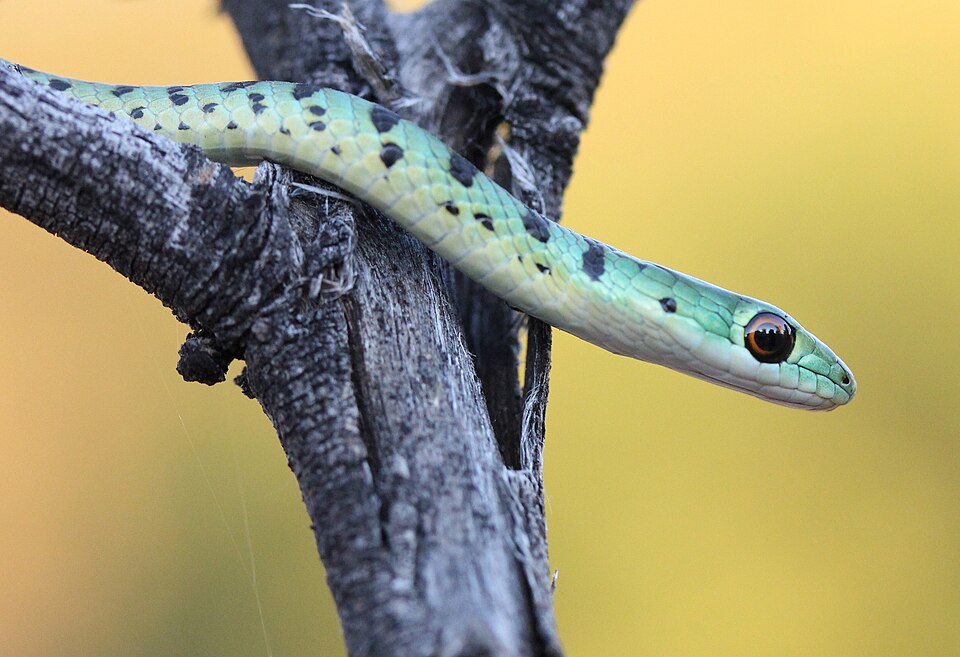
Nearly every green snake call on the Berea turns out to be the harmless Spotted Bush Snake. Nick Evans reckons around 80% of his call-outs are for green snakes, and roughly 95% of those are Bush Snakes.
Green Mambas are a coastal forest species and do not naturally occur in the built-up Berea. One did turn up in a Berea complex in 2020. It made the news precisely because it was so extraordinary. As Nick put it at the time, there is not a Green Mamba in every corner.
So: do not assume green means harmless, and equally do not assume green means mamba. Assume nothing, keep back, and call. The identification can wait.
 🔍 Enlarge
 Spotted Bush Snake
Philothamnus semivariegatus
Harmless
How to tell: Slender and bright green, with black spots or bars over the front half and a long tail. Big dark eyes. Usually up in shrubs, on walls or in the roof.
This is the snake you are most likely to see here, and the one most often killed by mistake. It is completely harmless, cannot hurt you, and spends its time hunting geckos and lizards. If something green disappears up a wall at speed, this was almost certainly it.
 🔍 Enlarge
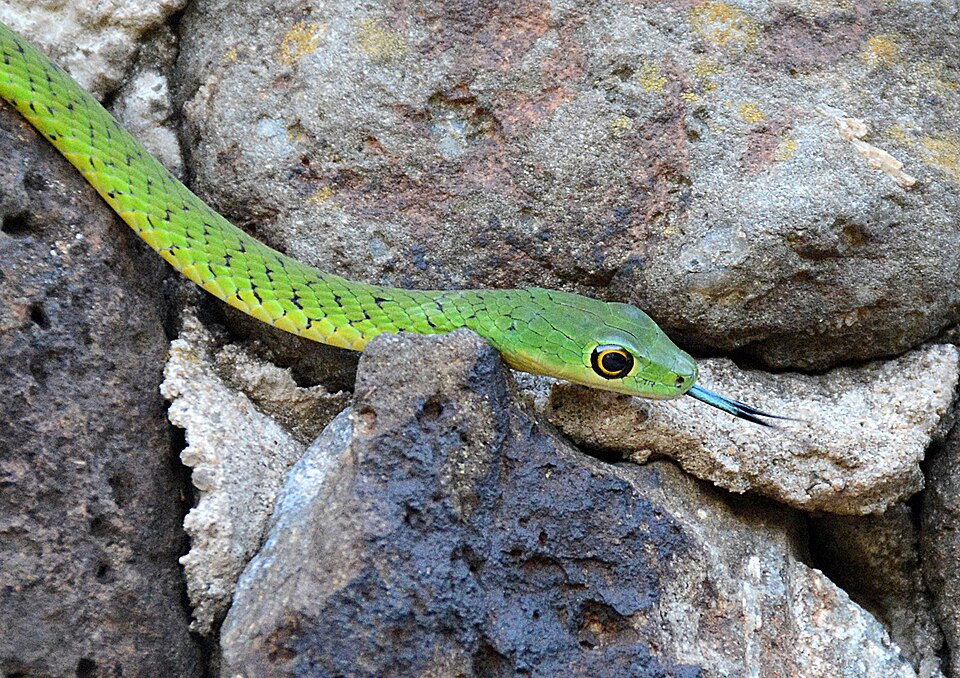
 Natal Green Snake
Philothamnus natalensis
Harmless
How to tell: Uniform bright green with no spots, slimmer than a boomslang and with a much smaller eye.
Another harmless green garden snake, often confused with the Spotted Bush Snake and, less fairly, with a boomslang. Eats frogs and lizards. Common in gardens with dense cover and a pond.
 🔍 Enlarge
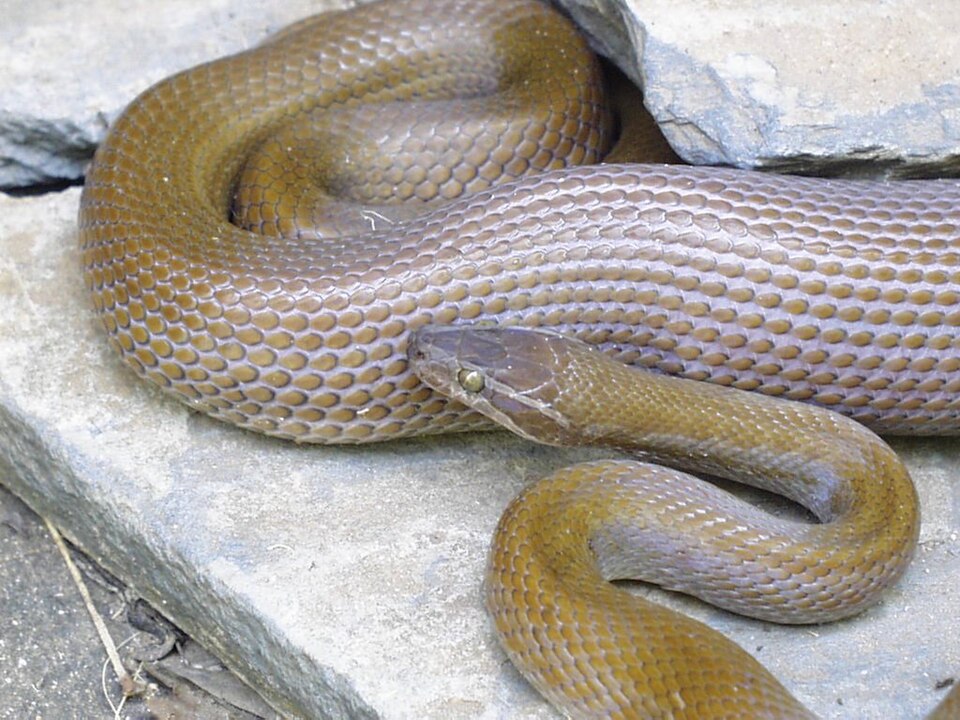
 Brown House Snake
Boaedon capensis
Harmless
How to tell: Plain brown to reddish, glossy, with two pale cream stripes running back from the eye across the side of the head.
One of the most useful animals that can turn up in your yard. Harmless to people and a serious rodent hunter. A house snake in the garden is doing exactly the job you would otherwise reach for poison to do. Often found near outbuildings and compost heaps.
 🔍 Enlarge
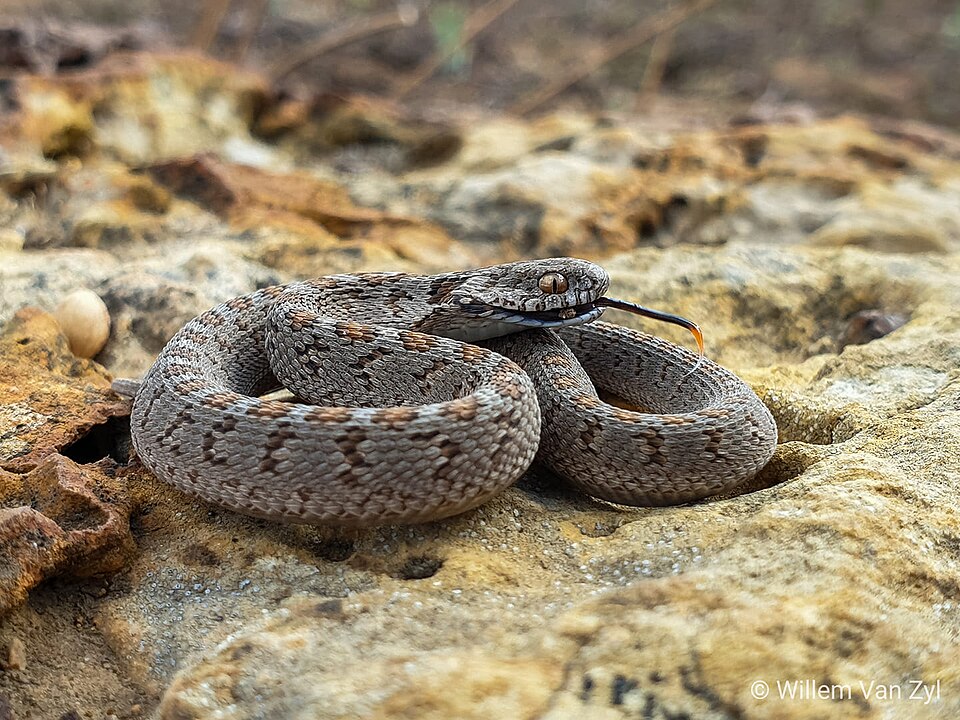
 Common Egg-eater
Dasypeltis scabra
Harmless
How to tell: Grey-brown with dark blotches down the back. Looks a great deal like a Night Adder, which is exactly the point.
Completely harmless, and has no teeth worth speaking of. It swallows birds' eggs whole. Its defence is to imitate an adder: it coils, rubs its scales together to make a rasping hiss, and strikes with its mouth closed. Very convincing, and the reason many are killed.
 🔍 Enlarge
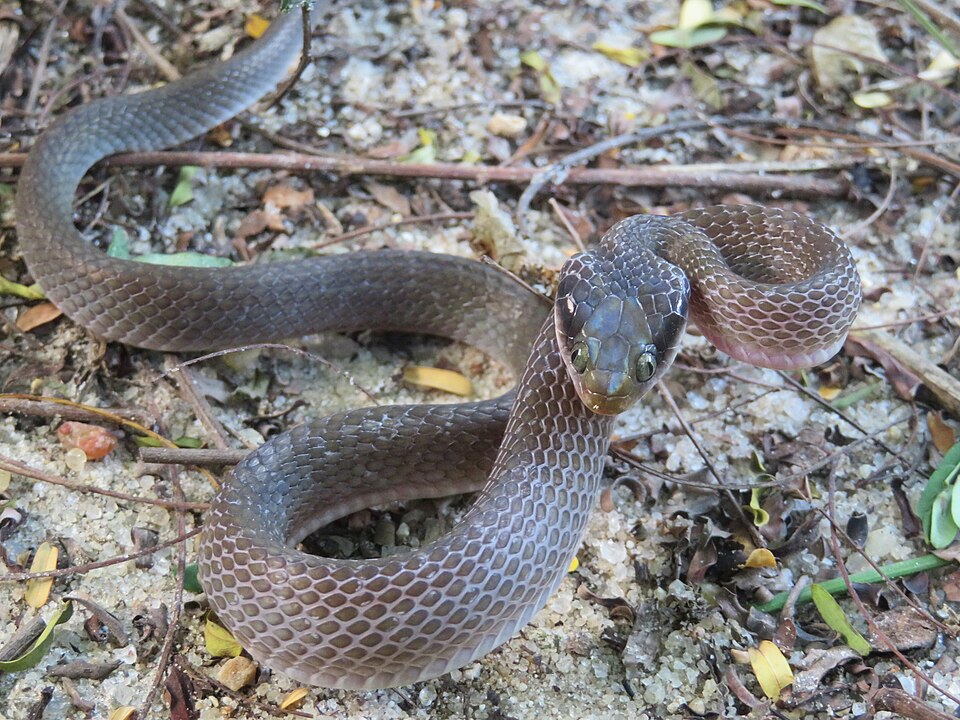
 Herald Snake (Red-lipped Snake)
Crotaphopeltis hotamboeia
Mildly venomous: not dangerous to people
How to tell: Olive to dark grey-brown, with a distinctly dark head and, usually, orange or red on the upper lip.
A common night-time garden visitor that comes out after rain to hunt frogs and toads. It puts on a big show when cornered, flattening its head and striking, but its venom is weak and it is not considered dangerous. Still not one to handle.
 🔍 Enlarge
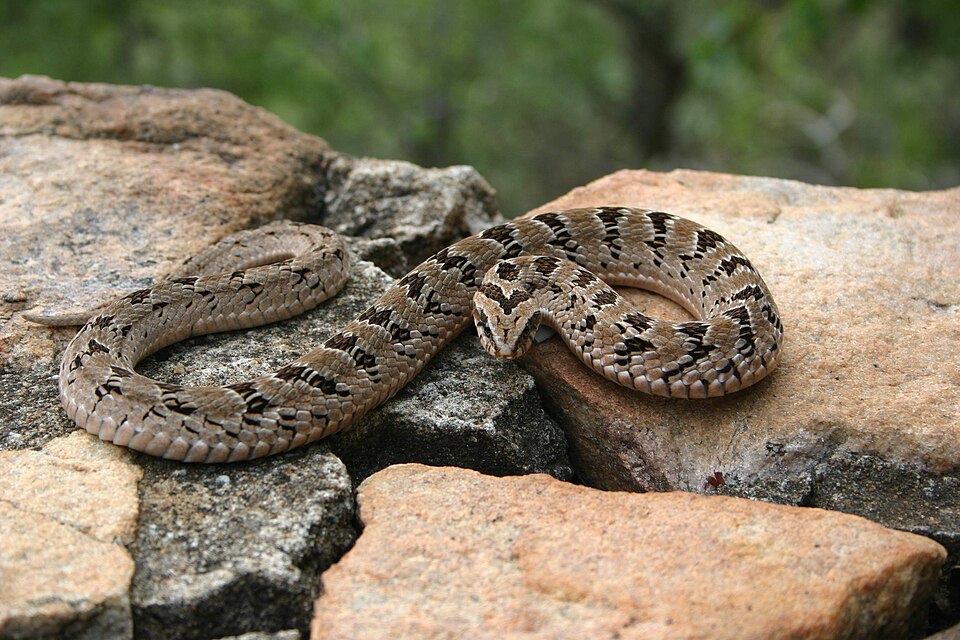
 Rhombic Night Adder
Causus rhombeatus
Venomous: painful bite, rarely life-threatening
How to tell: Stocky, grey-brown, with a row of dark rhombic blotches down the back and a dark V on the head.
Slow-moving and often found near water or compost, hunting toads. Its bite causes severe pain and swelling but is very seldom life-threatening. Frequently confused with the harmless Egg-eater. Bites usually happen when someone stands on one at night or tries to move it.
 🔍 Enlarge
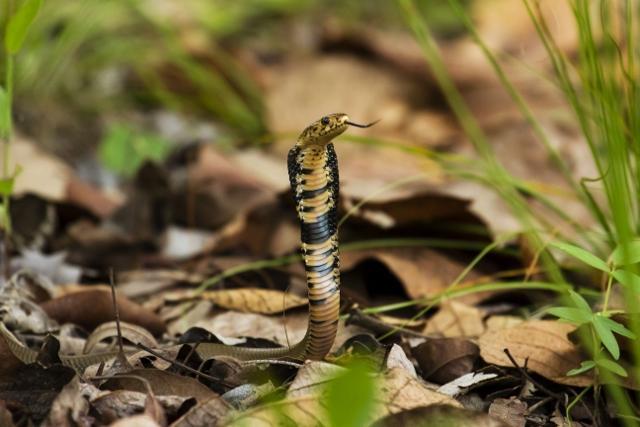
 Mozambique Spitting Cobra
Naja mossambica
Dangerous: medical emergency
How to tell: Slate to olive-grey above, often salmon-pink underneath, and spreads a narrow hood when it rears up.
Can spray venom several metres towards a threat's eyes, so keep well back and never crouch down for a closer look or a photograph. If venom reaches the eyes, rinse gently with large amounts of water and get to a hospital. Mostly active at night, and drawn in by rodents and frogs.
 🔍 Enlarge
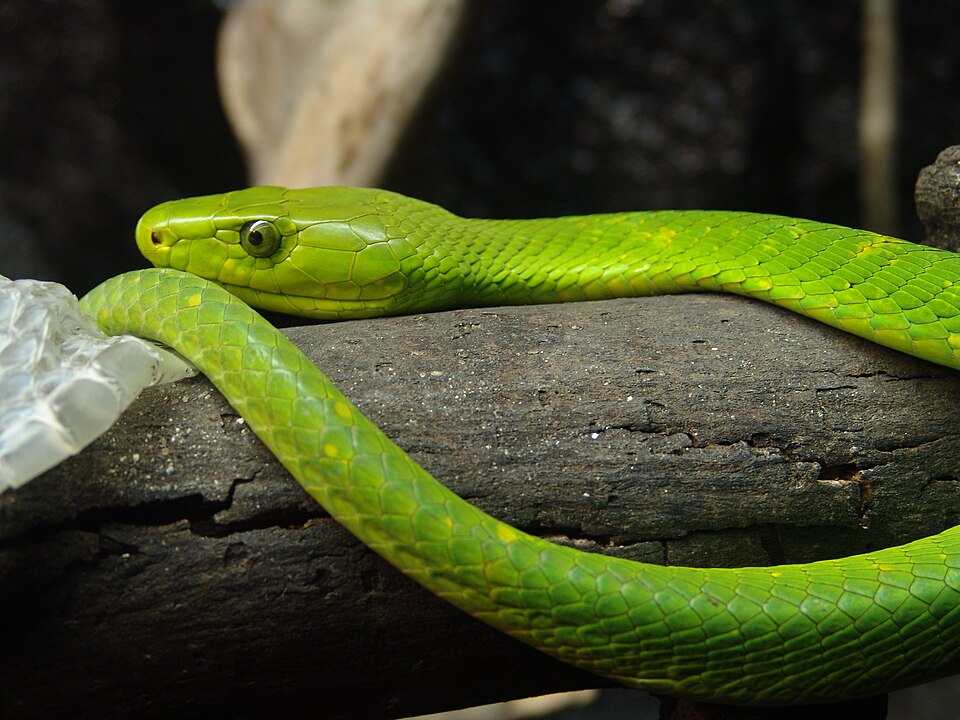
 Green Mamba
Dendroaspis angusticeps
Dangerous, but does not naturally occur here
How to tell: Uniform bright green, large, slender and long (up to about 2m). Narrow coffin-shaped head, smooth scales, and a plain green body with no spots or bars.
Included because people ask, and because it is worth knowing the real answer. Green Mambas are a coastal forest species, generally found within a few kilometres of the sea, and they do not naturally occur in the built-up Berea. One was rescued from a Berea complex in 2020, which made the news precisely because it was so unusual. The snake had almost certainly hitched a ride. If you see a green snake here, it is overwhelmingly likely to be a Spotted Bush Snake.
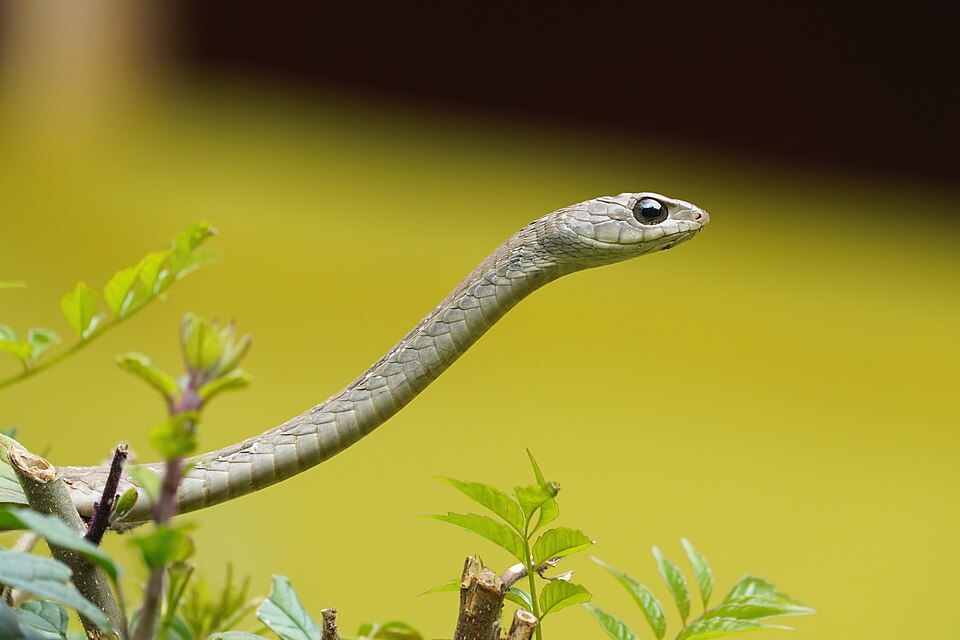 🔍 Enlarge
 Boomslang
Dispholidus typus
Dangerous: medical emergency
How to tell: Very large eye and a short, rounded head. Males often bright green with black-edged scales, females and juveniles usually plain brown or grey.
Lives up in trees and is extremely shy. It will almost always move away long before you notice it. Bites are very rare and nearly always involve someone handling one. Often blamed for harmless green snakes; the giveaway is that enormous eye.
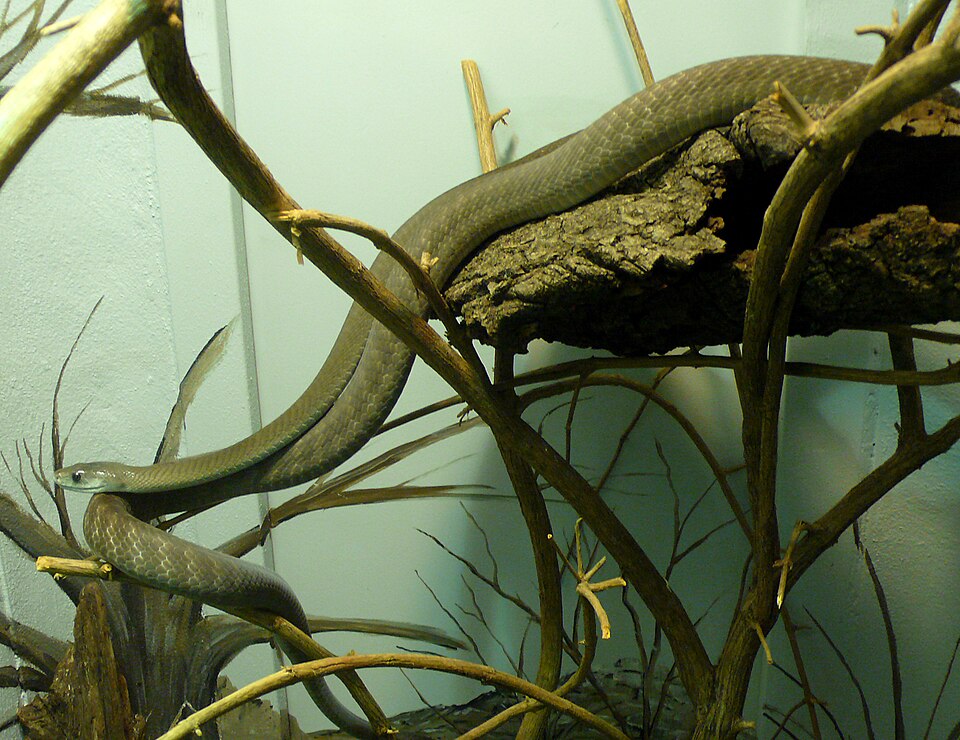 🔍 Enlarge
 Black Mamba
Dendroaspis polylepis
Dangerous: medical emergency
How to tell: Not black at all: gunmetal grey to olive-brown, long and slender, with a narrow coffin-shaped head. The name comes from the inky black inside of its mouth.
Present in the Durban area, though seldom seen. Its reputation for aggression is overstated: it is shy and its first choice is always to get away. Nearly every bite happens when someone corners one, tries to kill it, or handles it. Give it a clear route out and it will take it. If one is in your yard, keep everyone well back and call a remover immediately.
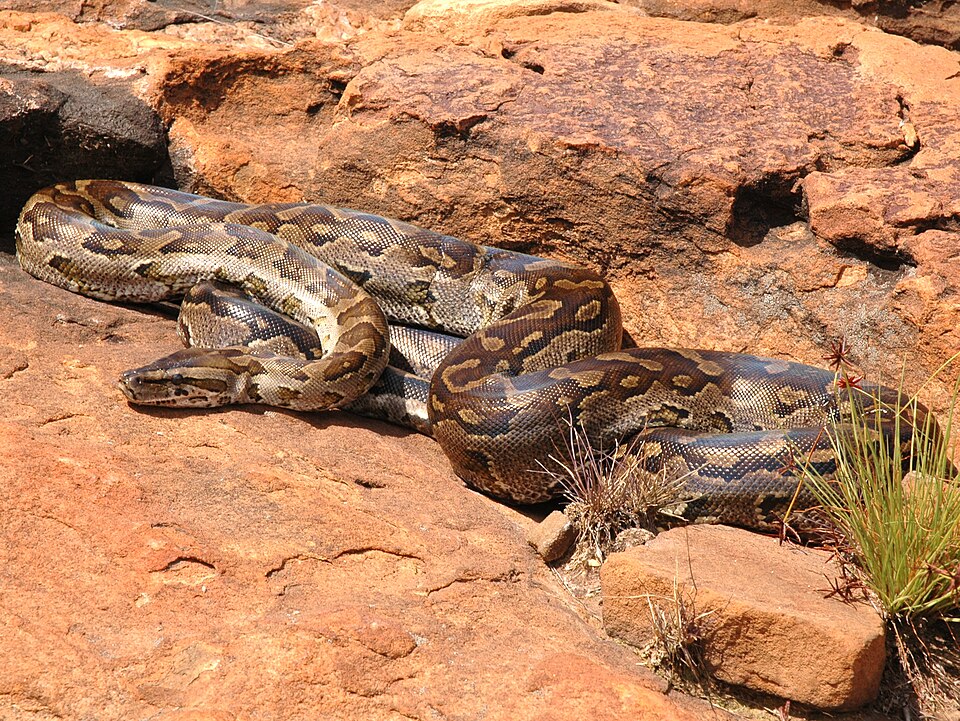 🔍 Enlarge
 Southern African Python
Python natalensis
Non-venomous, but large, and protected
How to tell: Very large and heavy-bodied, with dark blotches over grey-brown. Adults are unmistakable on size alone.
Not venomous, and a protected species. It is illegal to kill one. Turns up occasionally along the green corridors and river valleys around the Berea. A large python should only ever be handled by a professional, both for your safety and the animal's.
Please don't kill them
The snake most people actually see here is the Spotted Bush Snake: slender, bright green, completely harmless, and a good gecko-hunter. It gets killed constantly because it is mistaken for something else. Every snake killed for nothing is one less thing keeping the rodents down, and killing one is also where a lot of bites happen.
If you want to learn to tell them apart properly, the ASI runs snake awareness courses in Durban, including a Kids' Snake Awareness course. A much better way for children to learn this than from a website.
Photographed one from a safe distance? Add it to Spotted. A real photo is also how an expert can tell you what it actually was.